Today’s book is a departure from my usual type of book. The Financial Diet is subtitled A Total Beginner’s Guide to Getting Good with Money. This book was made available to me by the publisher, Henry Holt and Company. ( In other words, it was a freebie for my unbiased review.)
This is not your typical financial guide. Not anywhere near your typical financial guide. And that makes it a tad bit better. It is an interesting take on a finance book. This is a book for a young woman – probably great for a fresh college grad or someone just starting out. There are seven chapters – Budget, Investing, Career, Food, Home, Love, Action. Yes, you read that right – Food and Home are in there. There are even recipes included along with kitchen equipment that you should have to start a kitchen. The chapter on love includes the following quote:
“There is nothing more cringeworthy than having a relationship be your financial plan.”
It is written in a light and breezy style. My feeling is that the idea behind the book is to send you to join the website. Despite that, it is worthwhile for someone just starting off. It is very easy to read and understand. The author provides lots of personal history and “what not to do” moments. Also included in the book are sections from experts on finance and work.
So, if you are looking for a gift for a college grad or high school grad starting out, this might be a helpful gift for them.
I know this is a bit off topic but I have to say that I don’t like it when I don’t understand the title of a book. I find it irritating when the title is so esoteric that you cannot see a connection between the story and the title. When a title has to be explained, I don’t think it hits the mark. This is NOT the case with this book. You find out in the book what the title means.
Turtles All The Way Down is a story about Aza Holmes. Aza is 16, misses her dead father, and has OCD. Her OCD is not what one might think of as OCD. It is not the repetitive behavior like hand washing. Aza has thought spirals. She has thoughts that she can’t stop no matter how much she tries. She is under a doctor’s care but since she does not take her medicine as consistently as she should it does not help her much. Aza has a best friend named Daisy Ramirez. Aza is not a great friend in that she gets caught up in her thought spirals and is unable to pay attention as a friend might normally pay attention. It isn’t that she doesn’t care, it is that her mind can’t always be present with Daisy. They have been friends a long time and Daisy knows about Aza’s shortcomings as a friend and accepts them.
One summer after Aza’s father died, she went to what she calls “sad camp”, a camp for children with a deceased parent. At the camp, she met Davis Puckett. Davis lives down the river from Aza and his mother has died. At the time of the story, they had not seen each other for a couple of years. Davis’s father, Russell, is fabulously wealthy.
At lunch, Daisy is talking about Russell Puckett’s disappearance and the reward that is being offered for information leading to finding him. It seems he was about to be arrested for deceptive business practices and he just disappeared. He left his two sons behind with caretakers. Daisy would like to find information or Russell himself so that she can collect the reward. She remembers that Aza knew Davis and suggests that Aza can help her find Russell. Aza doesn’t believe that she can be of any help but goes along with Daisy. Aza and Daisy take an old canoe down the river to check out the Puckett estate. Aza recalls that when she knew Davis that there was a night vision camera in the woods by the river on their estate. Aza and Daisy get out of the boat on the estate to check and see if the camera is still in place. They get caught by a caretaker but Aza claims the is there to see Davis. Davis doesn’t really believe her – because his family is in the news so prominently and he thinks people are after the reward money. Aza and Davis reconnect and their friendship is rekindled. Davis does ask Aza not to work on finding his father. To get her to stop, he gives her money.
I think that the plot of the book is good. I will admit that I did get a bit tired of Aza and her thought spirals. They do serve the purpose of showing what it is like in her head but it was so relentless that I was wishing the story would move on. Yes, I got tired of her illness. And that was the point – her illness is hard to deal with both for her and for those around her.
I turned to her. “STOP TALKING. Jesus Christ, you haven’t shut up in ten years. I’m sorry it’s not fun hanging out with me because I’m stuck in my head so much, but imagine being actually stuck inside my head with no way out, with no way to ever take a break from it, because that’s my life. To use Mychal’s clever little analogy, imagine eating NOTHING BUT mustard, being stuck with mustard ALL THE TIME and if you hate me so much then stop asking me to – “
To be honest, I got caught up in the characters and forgot about the plot of the book partway through. When we circle back to Davis’s father, I wasn’t thinking about him any longer. I’m not sure if that is a good thing or a bad thing.
Overall, I am a huge fan of John Green’s writing style. There is so much cool information in with the story that I enjoy reading and listening to him. The characters in this book are flawed and that is one of the things that John Green does very well.
“A well-known scientist (some say it was Bertrand Russell) once gave a public lecture on astronomy. He described how the earth orbits around the sun and how the sun, in turn, orbits around the center of a vast collection of stars called our galaxy. At the end of the lecture, a little old lady at the back of the room got up and said: “What you have told us is rubbish. The world is really a flat plate supported on the back of a giant tortoise.” The scientist gave a superior smile before replying, “What is the tortoise standing on?” “You’re very clever, young man, very clever,” said the old lady. “But it’s turtles all the way down!”
Somehow, I had missed seeing The Dry on the bestseller lists during 2017. When it was picked by my book club, I had never heard of it. With all the books that I am dying to read, I hated to pull myself away to read this book. But, since I like going to my library book club, I read the book.
I was drawn in from the beginning. The book takes place in the Australian town of Kiewarra, which is a few hours outside of Melbourne. It is farm country which is suffering from its second year of a drought. And suffering is the word to describe it. The farmers don’t have the water to grow anything or give their animals. Money is tight all over the area. The town has lost most of its commercial district because no one has money to spend.
Aaron Falk grew up in this town. He and his father fled the town after Aaron was accused of the murder of Aaron’s friend Ellie Deacon. She was found drowned in the river with stones in her pockets. At the time of the murder, Aaron was given an alibi by his friend, Luke Hadler. Aaron knew that he had not killed Ellie but he was alone fishing when she was killed and therefore did not have a useful alibi. Aaron did not know where Luke had been but Luke was insistent that Aaron use the alibi that Luke gave him. Even with the alibi, there was a strong sentiment stirred by Ellie’s father and cousin that Aaron was her killer. Ellie’s father made Aaron and his father’s lives miserable until they packed up and left Kiewarra.
Twenty years have passed since Arron left Kiewarra. Aaron lives in Melbourne and is with the police. He has risen through the ranks and now investigates financial crimes. Aaron is called back to Kiewarra because Luke, his wife, and son were found dead. It looks like Luke killed his wife and son and then killed himself. Luke and his wife, Karen, had two children. Luke’s daughter, Charlotte, was found in her crib alive. Everything indicates that Luke snapped due to the draught and the resulting financial crisis.
Aaron was debating about going to the funeral. The town had not treated him well and he didn’t have any desire to go back. He knew that feelings would still run hot against him. But then Luke’s father sends him a message that read “Luke lied. You lied. Be at the funeral.”
Not knowing quite what to expect, Aaron meets with Luke’s parents after the funeral. Luke’s mother, Barb, asks Aaron to go through the financials. She thinks that someone killed Luke and his family. She feels sure that Luke borrowed money from an unscrupulous person and that person killed Luke and his family. Gerry, Luke’s father, doesn’t believe that. Both prevail on Aaron to look into the matter. Because they were so much a part of his life when he lived in Kiewarra, he decides that he has to look at the financials. He goes to Luke’s farm and meets Sargent Raco. Sargent Raco feels there is something wrong with the murders. Not enough to call back the police who originally investigated the crime yet but it doesn’t add up in his mind.
Did Luke kill more than just his family? What were those odd marks in the back of Luke’s pick up? With all the animosity in town, will Aaron make it out of town alive?
I really liked the book. I thought that it moved along at a good pace and you could visualize the scenes. No, I would not have guessed the ending.
I have something I have to admit to you. Sometimes I read too fast. I will blame it on my mother’s insistence that her children take speed reading. Reading fast is fine in many ways. I can read books, enjoy them and move on. Sometimes though, it catches up to me and I need to slow down.
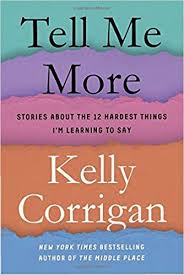
Tell Me More by Kelly Corrigan is one of those books I should have slowed down when I was reading. As a result, I have gone back and read it again. Tell Me More is a memoir. It is about the time in Kelly Corrigan’s life after her beloved Father’s death and her friend Liz’s death. Her coming to terms with those deaths and the clash of her grief meeting her real life of raising two teenage daughters and being a wife caused her to take a look at how she could be a better person.
The subtitle of the book is Stories about the 12 Hardest Things I ‘m Learning to Say.
“This book is about things we say to people we love (including ourselves) that make things better”
Each of the phrases that she is learning to say has a chapter that illustrates why she is learning to say it. For example, when her daughter calls her in tears about something that happened with her friends, Kelly was prompted by her friend to listen rather than try and jump in to “fix” the situation.
“I admitted that I can’t watch the girls climb a tree without telling them where to put their foot next. “I can sit on my hands for about eight seconds. When they tell me about a problem – which is rare and getting rarer – I can think of five things they should do before they finish their first sentence.”
“Right. But then, there’s that whole weird thing where half the time, it’s not even about what they are saying it’s about. So your advice is totally wrong because you don’t even understand what the real problem is or what they’re asking for.”
She let her daughter talk. She asked questions about how her daughter was feeling. She discovered that she was more helpful than if she had jumped in with solutions. By saying “Tell Me More” she was able to be a better sounding board for her daughter.
Kelly Corrigan is willing to let her readers see her as she actually is. She does not try to hide her warts. She does show that she is trying to be a better person. She isn’t a bad person – she is a person much like you or I with human frailties. It may be that she can see her flaws better than we can see ours.
I did like this book and I think it has many good points. It deserves to be on your TBR pile. I would also recommend her earlier book, Glitter and Glue: A Memoir. (My review of it can be found here.)
I am a bit overwhelmed by my TBR pile right now. There seem to be so many good books that have come out and I still have so many from before that I am feeling a bit flooded. Do you feel that way? Did you get any books during the holiday season that you can’t wait to read? Please share them in the comments!
If you would like to see and hear Kelly Corrigan talking about her book, here is a video you can watch.
Congratulations to Kelly Corridan as today is the publication day for this book. I received an advance copy of the book so that I could give an honest opinion of it.
Being Mortal by Atul Gawande is the book for my book club this month. The book’s subtitle is Medicine and What Matters in the End. This book is a thought-provoking read.
I will warn you that it is not an easy book at the start. In the author’s own words,
“This is a book about the modern experience of mortality – about what it’s like to b creatures who age and die, how medicine has changed the experience and how it hasn’t, where our ideas about how to deal with our finitude have got the reality wrong.”
It is a very hard subject. As Bette Davis so famously said, “Old age ain’t no place for sissies.” But keep reading. The book is very interesting and can give you an interesting perspective on aging and dying. After all, we all have to die. This book suggests that you might give it some thought ahead of time. Modern medicine can do many things to keep you alive and you may need to give some thought to what you really want – what is important to you as you grow old.
I was particularly struck by the thought that when we leave the decision making to loved ones that their perspective is different from our own.
“We want autonomy for ourselves and safety for those we love. That remains the main prolem and paradox for the frail. Many of the things that we want for those we care about are things that we would adamantly oppose for ourselves because they would infringe on our sense of self.
It’s the rare child who is able to think, ‘Is this place what Mom would want or like or need?’ It’s more like they’re seeing it thought their own lens. The child asks, Is this a place I would be comfortable leaving Mom?”
Perhaps because I have had to make this decision for my parents, I was hit more by this discussion. While I wanted them to be able to have their own apartment, I did not consider that they would have to live with a schedule. That they would have to be up by a certain time each morning so that my mother could receive the help she needed with bathing and dressing. That she could no longer decide that she wanted to stay in bed for an extra hour just because it felt good to do so. Would I want that for myself?
The author looks at how care for the elderly has evolved and highlights some places where the care seems to take into account the needs of the elderly to remain autonomous while still being cared for. The book uses examples of cases and how things were done and how things went well or could have been done better.
While a different, this book and the book, When Breath Becomes Air, both talk about what measures can be taken to keep a patient alive and whether the quality of life should play more of a role in the decision making. Medicine can do amazing things to keep a body going but the result of that intervention does not necessarily result in a better quality of life. That perhaps there needs to be a franker discussion about the possible and probable outcomes of some interventions.
When I finished this book, I called my brother to tell him to read this book. He told me that he had read it twice and given it away to two people. (I did not ask why he hadn’t given it to me or even recommended it to me. Brothers…) I then sent a copy to my sister and told her she had to read it. So, yes, I recommend this book. Not an easy subject but it is handled so well in this book. It is a very interesting read.


 This is not your typical financial guide. Not anywhere near your typical financial guide. And that makes it a tad bit better. It is an interesting take on a finance book. This is a book for a young woman – probably great for a fresh college grad or someone just starting out. There are seven chapters – Budget, Investing, Career, Food, Home, Love, Action. Yes, you read that right – Food and Home are in there. There are even recipes included along with kitchen equipment that you should have to start a kitchen. The chapter on love includes the following quote:













 Carol Early Cooney