About Alice by Calvin Trillin

Sculpture  located in Kaszubski Square, Gdynia, Poland.

Sculpture located in Kaszubski Square, Gdynia, Poland.

I was about a block away when I saw the couple on the bench. As I moved closer, I could see her occasionally say something to him. She would sit up and tilt forward and he would look out over the water in response. As I got closer, I could see that they were holding hands and leaning on each other while sitting on the bench. They were silent most of the time and they looked comfortable with that silence. I assumed that they were two people who had been together a long time and just fit together. They didn’t need to talk. They spoke volumes with their body language.    

How do you envision a love story? It is full of passion and proclamations of love? Can a love story be told without that? Can you read a story and just know that there was so much love that time cannot diminish it?

About Alice

When I read Calvin Trillin’s About Alice, I read such a book. It is an amazing tribute by the author to his wife. It is the love that Calvin has for Alice that shines forth. He does not tell you that he loved her as much as he shows you from his stories of their lives together.    I found the book very touching.

The book is brief. There are less than 90 pages. My copy includes two additional stories from the book Quite Enough of Calvin Trillin.

In the book Calvin Trillin tells the story of how he met Alice and her version of the story.

“Alice would sometimes say, “You have never again been as funny as you were that night.”

“You mean I peaked in December of 1963?” I’d say, twenty or even thirty years later.

“I’m afraid so.”

Alice developed lung cancer at age 38. She survived having cancer and lived to see her two daughters grow up and get married.

“A couple years after Alice’s diagnosis, I realized that I wasn’t thinking about it all the time. Gradually, we had found ourselves back in or regular lives. …

… I was walking through the airport to catch a plane back to New York when, apropos of nothing, the possibility that things could have gone the other way in 1976 burst into my mind. I could see myself trying to tell my girls that their mother was dead, I think I literally staggered. I sat down in the nearest chair. I wasn’t in tears. I was in a condition my father would have called poleaxed. A couple people stopped to ask if I was all right. I must have said yes. After a while, the pictures faded from my mind. I walked to the gate and caught my flight to New York.”

Alice died of heart failure at the age of 63 in 2001.

Calvin Trillin is the author of 18 books. He has been on the staff of Time Magazine and The New Yorker. He has appeared on television talk shows – he was on the Tonight Show with Johnny Carson over 30 times. He has been awarded the Thruber Prize for American Humor (2012) and was inducted in 2013 into the New York Writers Hall of Fame

This book was published in 2006. If you are interested, I would check your public library.  It is, of course, available from Amazon.

Thanks for reading.

IMG_2483 (2)IMG_2483 (2)IMG_2483 (2)IMG_2483 (2)

Posted in Talking Books | Tagged , , | 4 Comments

The Art of Travel by Alain de Botton

IMG_2827


If you asked me, I would tell you that I don’t normally read travel books. I would not even put it on the list of types of books that I would want to read.

But I was wrong.

The Art of Travel

Before I left on my recent vacation, a friend gave me the book, The Art of Travel by Alain de Botton. I had never heard of the book and had no idea what it was about. The friend just told me that she had loved the book years ago and thought I might like it.

To be honest, if I was not traveling, I might not have read this book very quickly. I have a serious backlog of books that I want to read so introducing a book that I knew nothing about would not usually move it to the top of the pile.

That would have been a mistake.

Let me say first of all that I loved this book. Then let me tell you that I am having a terrible time trying to figure out how to describe it to you. This book is a bit about travel, then also about travel and the human condition, and then a bit of history and biography thrown in to complicate the description.

I was caught in the first section of the book when the author described how he saw a picture of a beach and palm tree in Barbados and decided that he had to escape the cold and dark in England to go to Barbados. He writes that he finally gets to the hotel room (after doing the travel part which is usually left out of our thinking of getting to a destination) and gets up in the morning and walks out to see the view that he has been dreaming of for months. He notes that instead of soaking in the scene, he finds that he is thinking about how he seems to have a tickle in his throat, he remembers he forgot to tell a colleague something about work, and then that he feels the need to go to the bathroom.

A momentous but until then overlooked fact was making itself apparent: I had inadvertently brought myself with me to the island.”                                                          

― Alain de BottonThe Art of Travel

With that scene, I was hooked. It was so right. It is exactly what I fight when I am traveling. Wonderful places and things but I still get lost in the things that were on my mind before I left – the things that I am trying to escape when on vacation.

IMG_2830 (2)

Mr. de Botton writes a book that entwines his travel experiences and observations with the travel experiences of historical figures (some much more famous than others.) I found his references interesting. So often, I found myself thinking that he had just hit the nail on the head.

“Valuable elements may be easier to experience in art and in anticipation than in reality.
The anticipatory and artistic imaginations omit and compress, they cut away the periods of boredom and direct our attention to critical moments and, without either lying or embellishing, thus lend to life a vividness and a coherence that it may lack in the distracting woolliness of the present.” 

― Alain de BottonThe Art of Travel

He talks about Gustave Flaubert’s desire to see the “Orient”. (By which Flaubert meant North Africa. Saudi Arabia, Egypt, Palestine, and Syria. He seems to have been a bit geographically challenged. ) and what happened when he finally traveled there. He talks about Vincent Van Gogh’s Provence, and William Wordsworth’s Lake Country.  He also has other historical characters that are not so well known but had interesting views on traveling. (Including a reference to Xavier de Maistre. De Maistre wrote a piece named Journey around my Bedroom. )

The book was originally published in 2002. I think you should be able to find it at your local library or it is available in electronic format or paperback from Amazon.  I think that you will find it an interesting read.

(The true measure of how much I liked it – it probably took me longer to read this book than any other on the trip. Not because it was long but because I found myself intentionally going slow to enjoy the writing.)

Thanks for reading!

IMG_2483 (2)

IMG_2483 (2)IMG_2483 (2)

IMG_2483 (2)


Yes, I have put in links to Amazon pages for your use if you wish to buy the book. Yes, I could get a commission for the sale if you buy the book by using my link. Before you think that I am a money grubbing little blogger, I would like you to know that I have yet to make ONE PENNY from the links. If it was my get rich quick scheme, it woefully misfired.


Posted in Talking Books | Tagged , , | Leave a comment

For My Son

Today on Julia Tomiak’s blog “Diary of a Word Nerd”, Eli Pacheco as a guest writer talked about the three books, songs, and quotes he would put in a time capsule for his three daughters.  Please read his insights here.

This started me thinking about what I would put in a time capsule for my children.  My children are two very different people.   When they were growing up, I had to treat them differently so I think I think of them separately in this also.

The following is the time capsule that I would put together for my son.

Books

The Lion, the Witch, and the Wardrobe by C. S. Lewis

Okay, yes, right off the bat I am cheating a bit.  I really mean that he should read the whole series.  They are some of the original adventure books and while meant for children, they may really be better for adults.  (Hint – The Lion, the Witch, and the Wardrobe is not the first book in the series.)

The_Lion,_the_Witch_._._._-_geograph.org.uk_-_317441

The Power of Habit by Charles Duhigg

The book is interesting because it is about how habits are formed but there are also really interesting examples in the book about habits and corporate America.  This book has both practical information and examples of the applications of the ideas in the book.

Walking on Water by Madeline L’Engle

Madeline L’Engle is one of my favorite authors.  This is my favorite book by her.  For my son, who had not found a hard road that he doesn’t love, I would hope this book would be a help in his life.

walking on water

CDs

Moondance by Van Morrison

Sorry, this is just the best CD ever made.  I really don’t care if you don’t agree.  It is perfect.

Reverse Thread by Regina Carter

Regina Carter plays the jazz violin.  Come on, how often do you hear the jazz played on the violin.  Okay, you should probably read a bit of her story also.  It adds a dimension to the music.

Now the third choice is hard.  The first two are pretty mellow and calm.  The third choice seems to me to need to be something that you can stand in the kitchen and sing – I mean sing really loud, maybe poorly but LOUD.  I would pick some country music but I know that would be rejected out of hand. So this is my odd choice.

kinks

Come Dancing with the Kinks (Best of the Kinks 1977-1986) by the Kinks

Yes, I went there.  So, listen, the words aren’t hard and sing in the kitchen.  Sing loud.  Sing and laugh.  Sing and dance.  Come on.. it’s “Lola”. L O L A, Lola.

Quotes

I am a bit of a quote junkie.  It is so hard to pick just three but here we go…

“Dance like no one is watching,
Live like you’ll never be hurt
Sing like no one is listening
Live like it’s heaven on earth.”

 William Purkey

“If ever there is tomorrow when we’re not together… there is something you must always remember. You are braver than you believe, stronger than you seem, and smarter than you think. But the most important thing is, even if we’re apart… I’ll always be with you.”

A. A. Milne

pooh and piglet

“If ever there is tomorrow when we’re not together… there is something you must always remember. You are braver than you believe, stronger than you seem, and smarter than you think. But the most important thing is, even if we’re apart… I’ll always be with you.”

A. A. Milne

“Laughter cleans the soul.  Our souls are so clean.”

Ann Naylon Knapick

“Life should NOT be a journey to the grave with the intention of arriving safely in an attractive and well preserved body…but rather to skid in sideways, chocolate in one hand – martini in the other, body thoroughly used up, totally worn out and screaming WOO~HOO – What a Ride!”

Unknown

So, I didn’t do just three.

Those are my choices for my son.  I am not sure he will appreciate them but those are the chances we take as parents.

Reminds me of a quote about leading a horse to water….

Thanks for reading!

Posted in Miscellaneous Thoughts, Talking Books | Tagged , , , , , , , , | 2 Comments

The Journal of Best Practices by David Finch

Journal of best practices

I am intrigued by the brain.  I have gotten more interested over time as I have watched my parents struggle with forms of dementia.  While heartbreaking, it is also so amazing to see how each day can bring differences.

There has been so much on the news about autism spectrum disorders. In my lifetime, the first exposure might have been the movie Rainman or watching interviews on news shows with someone with savant syndrome.  But now there are frequently articles about the rise in the diagnosis of autism spectrum disorders.

So, it was with interest that I read the book The Journal of Best Practices by David Finch. The subtitle for the book is “A Memoir of Marriage, Asperger Syndrome, and one Man’s Quest to be a Better Husband.”

SYNOPSIS

David Finch was always a bit different.  Not everyone realized how different but there were signs that his mind did not work the same way that most people’s.  He and Kristen met in high school and were best friends. They hung out and enjoyed the same things. As will happen, they grew apart but then due to a variety of circumstances their relationship grew after college and they married.  David had a good job as an engineer and Kristen worked as a speech therapist. But after five years and two children, the marriage was just not going well.  They were both unhappy.  One night, Kristen asked David to come down to her office and take a test.  After going through the lengthy quiz, David’s score for Asperger Syndrome was very high.  (Kisten was not diagnosing him – he then went to an unrelated professional for evaluation and diagnosis.)

The diagnosis was extremely helpful for them.  David particularly took it to heart and started writing down notes about the things that he needed to improve to help their relationship.  The perhaps most quoted note was “not to turn off the radio when Kristen is singing along with the song.” The collection of notes and thoughts became his “Journal of Best Practices.”  Things that he found that he needed to learn or change to make him a better husband for Kristen.

OPINION

This book is fascinating.  I found it so interesting that David could explain so well how his mind worked and the things that he would do to prepare for his everyday life.  He referred to himself as a chameleon.  He would observe behaviors and then copy those behaviors to be able to fit in to his surroundings.  Imagine trying to script out every part of your daily life ahead of time.  It would be exhausting.

He can explain  his lack of comprehension for parts of everyday life and how what he could change to make their relationship better.  Parts of the book are funny and in other parts it is easy to see how hard it is for David and Kristen.  He is trying so hard and sometimes he just needs to back off.

Overall, it is the portrait of two people who love each other trying to work with their differences.

David and Kristen have been interviewed many times since the book was published.  One such interview was on NPR. You can also find out more about them at David Finch Writer.

IMG_2483 (2)IMG_2483 (2)

IMG_2483 (2)


Thanks for reading!

Posted in Talking Books | Tagged , , | Leave a comment

The Orphan Train by Christina Baker Kline

Orphan_train_flyer

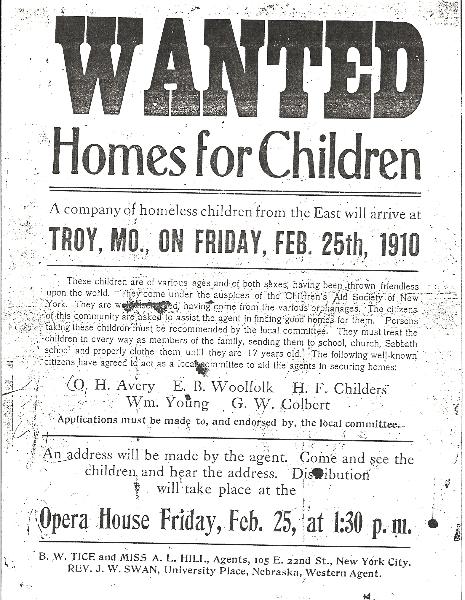
From 1853 until 1920, the Children’s Aid Society in New York and then later the Catholic New York Foundling Hospital would take homeless children from the East Coast to the Midwest. The goal was to provide the children with homes and families. Charles Loring Brace, who started the Children’s Aid Society felt that having children living in institutions was not right. He felt that only with work, education, and family settings would the children develop into self-reliant individuals.

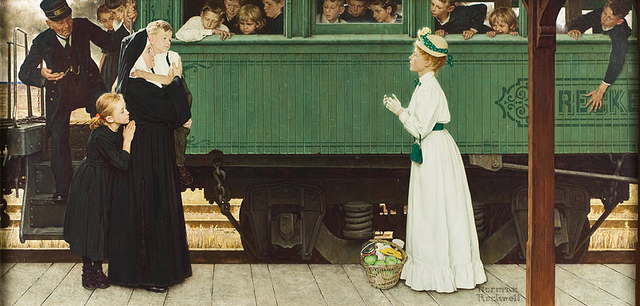
Rockwell orphan train

This picture paints what may be a lovelier picture than reality suggests.

It is thought that over 200,000 children were taken to the Midwest on the orphan trains.  At first, the trains were little more than cattle cars transporting the children. The accommodations did improve over time. The trains would have an itinerary of towns where the train would stop and the children would be herded into a hall to be looked over by townspeople that wanted to take in a child. If not taken in one town, then the child would move on to the next town and see if they were taken in the next town.

Some of the orphans benefited from the move. Others were treated as indentured servants or worse. Siblings were separated. The orphan trains were discontinued in 1920 when a new system called foster care was started.

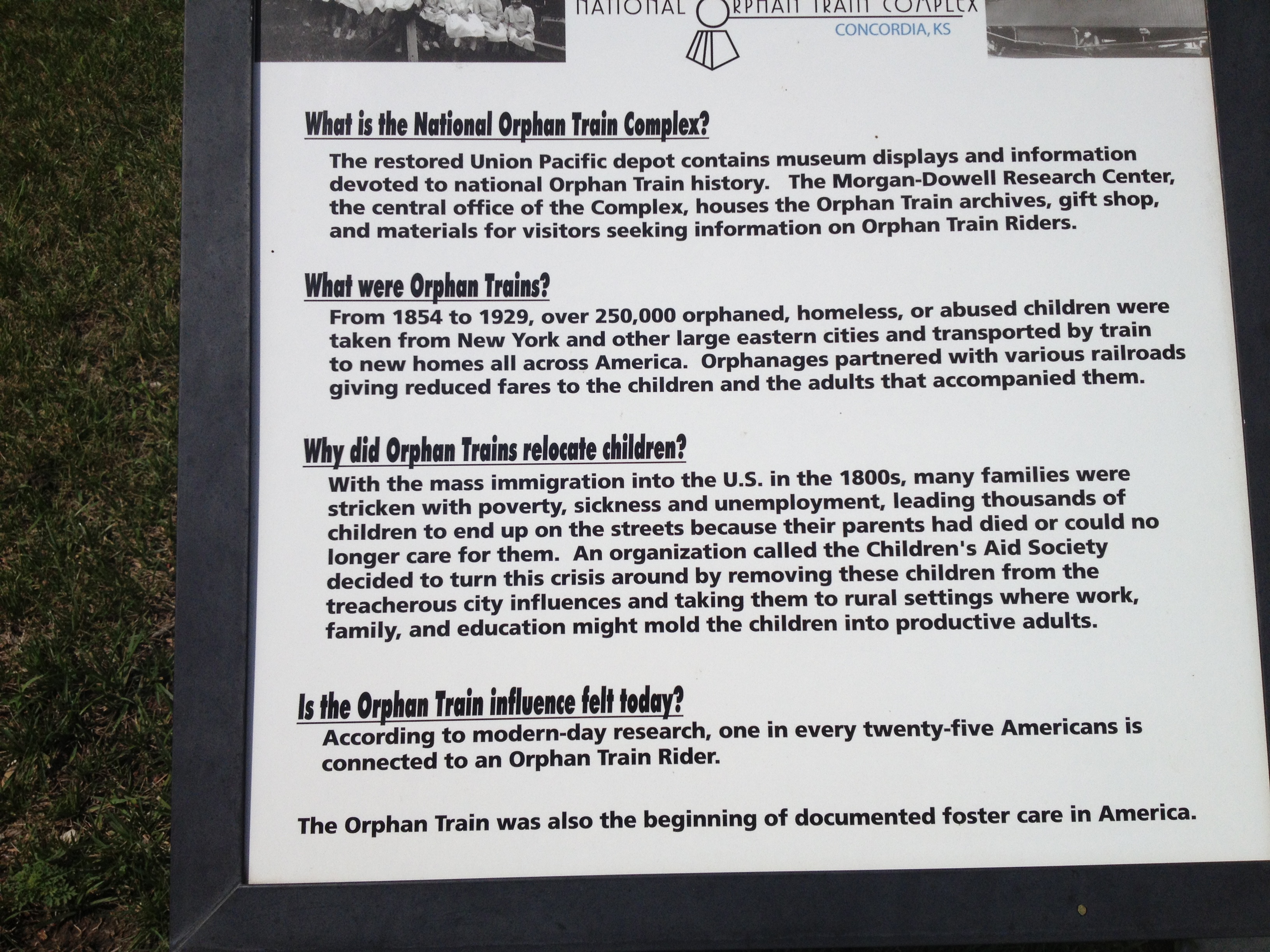
There is a National Orphan Train Museum and Research Center in Concordia, Kansas.

National_Orphan_Train_Museum_Plackard


The Orphan Train by Christina Baker Kline

Orphan Train Book


As you may have guessed, the real orphan train plays a part in this work of fiction. I did not know very much about the orphan trains. I find it fascinating that according to the Nation Orphan Train Museum and Research Center one in every twenty five Americans is connected to an orphan train rider.

SYNOPSIS

Molly Ayer is in foster care and is not doing well. Her foster mother did not want her and obviously disapproves of her. She is one step away from going to juvenile hall. To try and keep her out of juvenile hall, her boyfriend gets her a community service position helping an elderly woman clean out her attic.

Vivian Daly had a family. They came to the U. S. from Ireland to find a better life. It did not work out that way. There was a fire in the building where they lived and Vivian was told she was the only survivor from her family. She is eventually put on an orphan train.

As Molly helps Vivian go through all the boxes in the attic, Molly learns the story of Vivian’s life and Vivian finds out more about Molly. While some have suspicions about Molly’s intent, she and Vivian create a bond based on their backgrounds.

OPINION

I had put this book on my Summer Reading List and was subsequently told that it was not that good. Since I seem to find plenty to read, I was surprised and did not move very fast to get the book. I was away with a friend who was reading the book so I grabbed it when she finished.

I think that we all are affected by books differently at different times in our lives. I thought the book was very good. It was an engaging read and the story moved along well. The characters were sympathetic and well drawn. Reading about the two orphaned woman’s parallel lives make each more understandable.

IMG_2483 (2)IMG_2483 (2)IMG_2483 (2)


Thanks for reading!


Posted in Talking Books | Tagged , | Leave a comment